How to change a tractor tyre single-handed *

*Um, almost. LSS did help with holding tyre levers!

(français ici)

The background story

About a month ago I noticed that one of the rear tyres on the tractor had developed a split in the side wall. This was not entirely unexpected; the tyre had been well past its use-by date when we arrived in France in 2012!
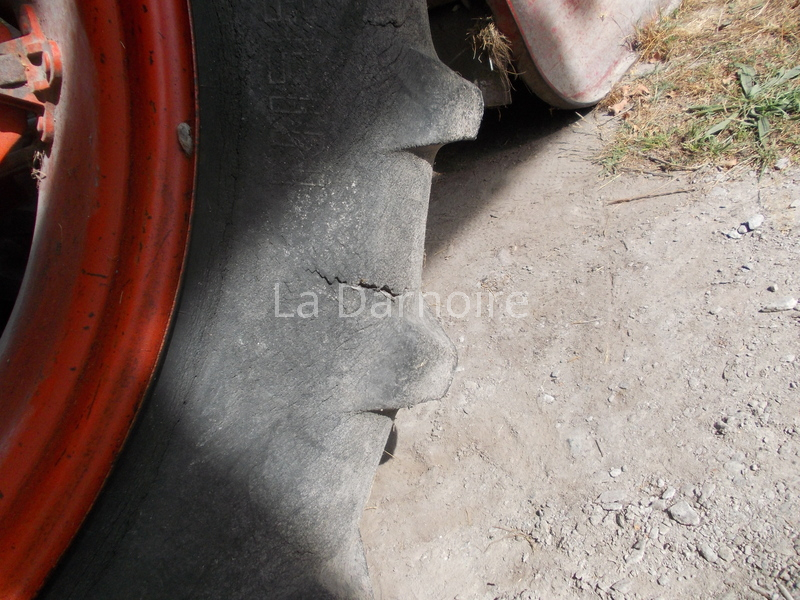
Old perished tyre
Old perished tyre

So after some research, I purchased a replacement tyre online. The price was painful. Mind you, it is a large tyre, a 16.9-38, weighing in at 90kg.

A few days later it arrived. Well, not without issues. The delivery company stopped at the end of the tar road, approximately 400 metres away from La Darnoire. The driver telephoned, and said they were not prepared to go any further and get their tyres dirty. So if the mountain won’t go to Mohammed…

The truck driver was a – shall we say – fairly large woman. She explained that she was afraid of damaging the canvas sides of her 18-tonne lorry on low-hanging branches. She pushed the tyre off the vehicle, (Tail lift? Pah! That’s for wimps) and I signed the paperwork.

The only way of getting this 90kg beast back to the farmhouse was by rolling it. This did not go easily, as it refused to roll in a straight line. I eventually made it, covered with sweat. Who needs to go to the gym when living here?

Planning the operation

Now for the next task, fitting it to the tractor. This was not something I wanted to do. Fortunately in a nearby town a small one-man business with the name GT Pneus specialises in changing tyres, including those on agricultural vehicles – and they also do house calls. We’ve used him in the past for car tyres. These I am quite capable of changing myself; but the problem lies with balancing them. So LSS gave him a call.

I should mention at this point that all four tractor tyres contain a puncture-sealing liquid. I became tired of patching tubes; there are a lot of thorny Prunus spinosa (sloes) around here. Fortunately it was always the front tyres of the tractor which were affected! So I obtained a puncture prevention liquid called Linseal OKO from the UK (this was obviously before Brexit). I have not had a puncture since.

When LSS mentioned that the old tyre contained this liquid, the tyre-change chappy immediately said a new tube (and, of course, replacement liquid) would be required. Because of the polystyrene beads, the liquid would have formed a solid coating around the inside of the tube, making it impossible to remove without destroying the tube. A new tube would add to the cost of the callout, bringing the total price to around €300. LSS said she’d get back to him.

It was obvious that GT Pneus had no experience with Linseal OKO. It does not contain polystyrene beads. And remains in liquid form.

It was also obvious that I would have to change the tyre myself. Oh joy. You see, even if I did fit a new tube, I would also need to purchase more Linseal OKO to put in it. And getting anything from the UK these days is a major problem. Not to mention the transport being expensive.

Changing the tyre

After some careful thought, I calculated that the biggest problem would be breaking the beads on the tyre. The only way to do this without purchasing expensive beadbreaker tools was by having the tyre on the ground. The wheel nuts proved to be “torqued” exceedingly tightly, requiring the use of an extension tube on the 1″ socket wrench.
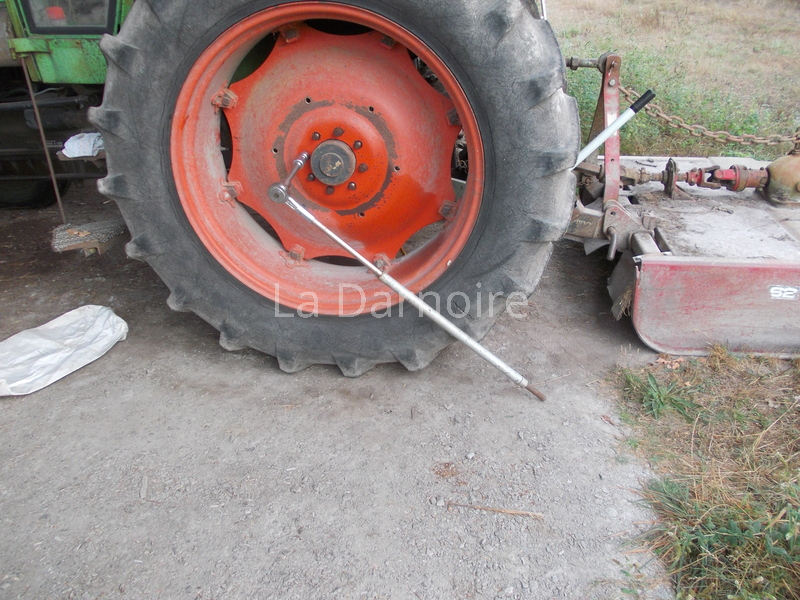
Removing the wheel nuts

With the wheel nuts loosened, the rear of the tractor was raised by means of a trolley jack and sturdy oak blocks. The wheel was then removed and laid flat. Well, I say laid flat. It was too heavy to lay flat gently, so it basically fell off under its own weight.
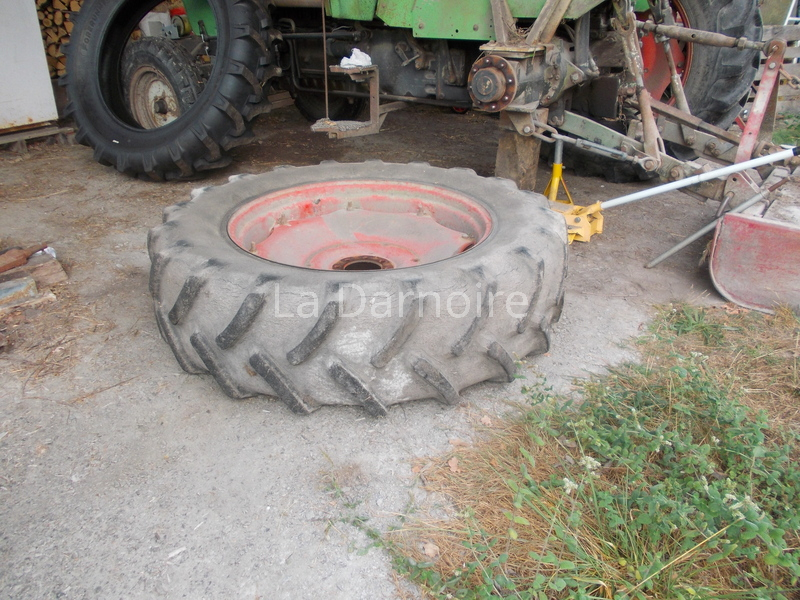
Wheel is removed
Wheel is removed

You will note I had placed an axle stand under the tractor for added security.

Now to break the bead. I have a Hi-Lift jack, so using a large chunk of steel, some heavy chains, and the Hi-Lift, I was able to carry out this task.
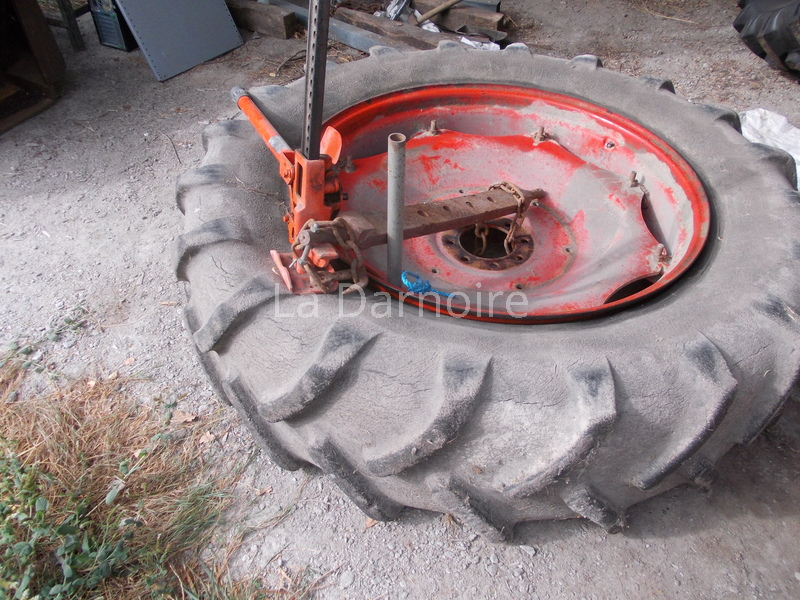
Breaking the bead
Breaking the bead

Ignore the vertical piece of pipe; it was just there to hold the jack upright while I took the photo.

The wheel now had to be turned over so that I could break the other bead. I did this by using the late Aged FIL’s block and tackle. The ancient rope snapped at the last minute, fortunately just as the wheel came upright.
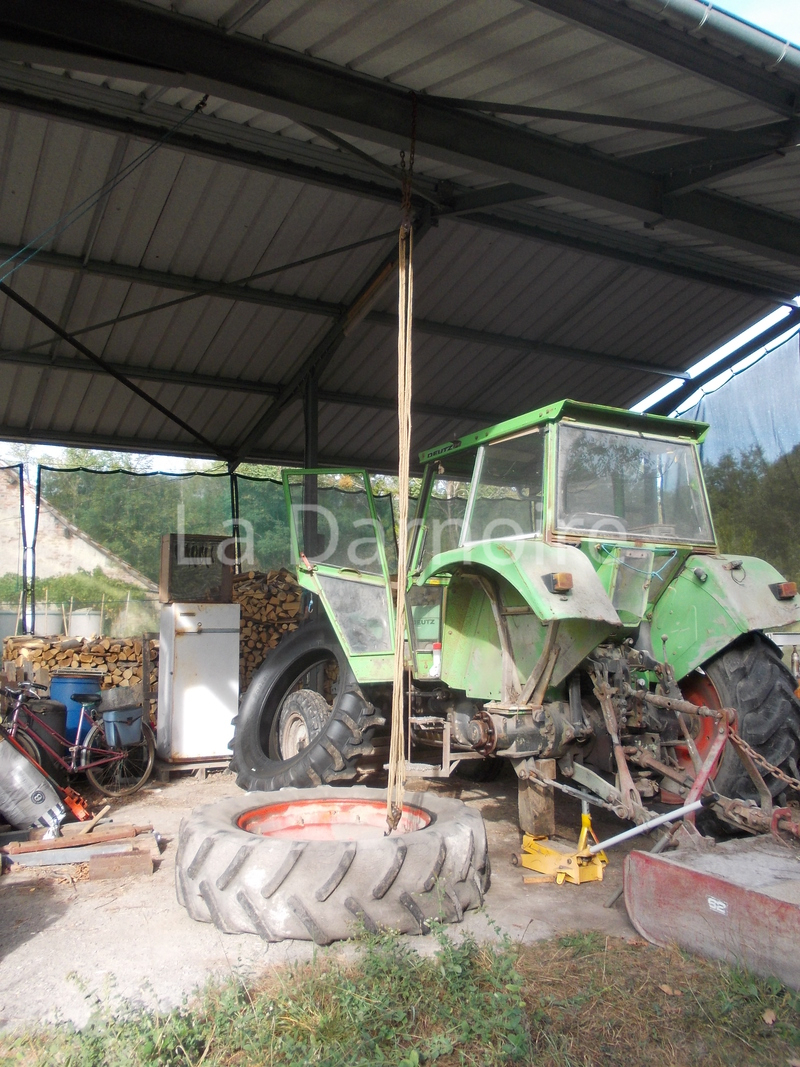
Block and tackle
Block and tackle

Well, nobody said this job was going to be easy! I then enlisted LSS’s help in putting the wheel back on the tractor (I jacked the tractor up and down with the trolley jack until the wheel studs aligned).

The outer bead was then levered off the rim. I used a length of rope to retain one tyre lever whilst employing the extension tube to increase leverage on the other. These tyres are tough!
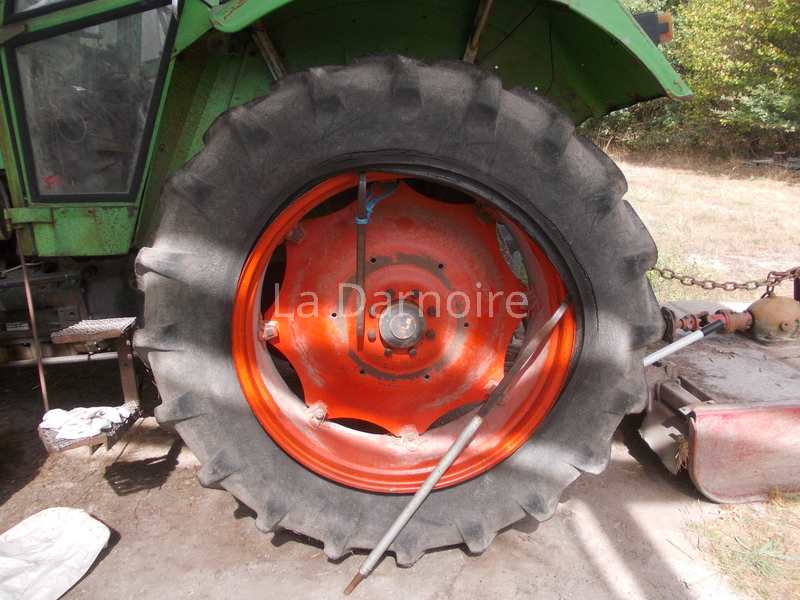
Using tyre levers to remove the tyre

Now to get the tube out without damaging it. I used a length of rope around the tyre, connected to a ratchet strap fixed to one of the hangar steel support posts. This enabled me to pull the tyre outwards sufficiently to be able to get the tube out. LSS assisted with this as well. Even the tube itself is heavy, bearing in mind it also contains around 6 litres of liquid! (By the way, it was fully deflated at this point, even though it does not look like it on the photo, as I had completely removed the Schrader valve.)
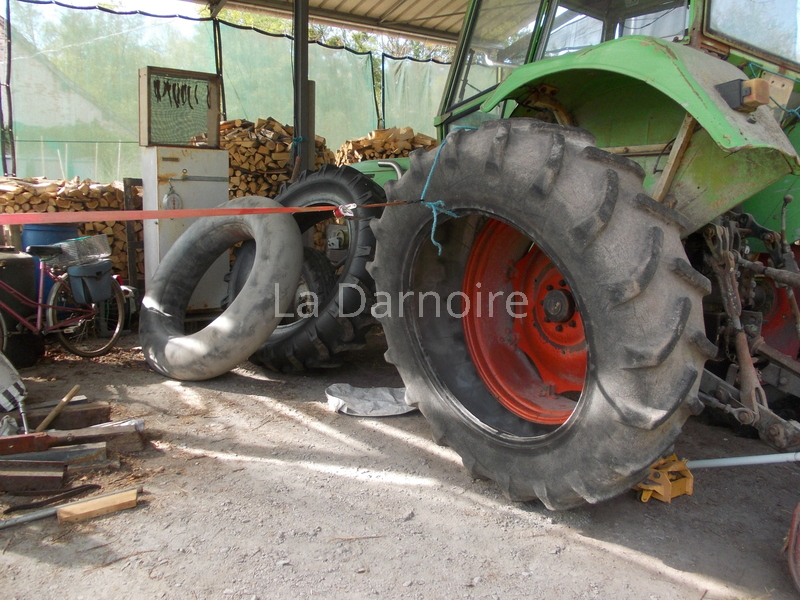
Inner tube removed
Inner tube removed

And in case you were wondering, the box on top of the old refrigerator (which is now a meat smoker) is our biltong dehydrator.

I struggled to get the other bead off the rim despite using copious amounts of lubricating wax (the Aged FIL had a large tub of this tyre-changing stuff). But eventually I succeeded.
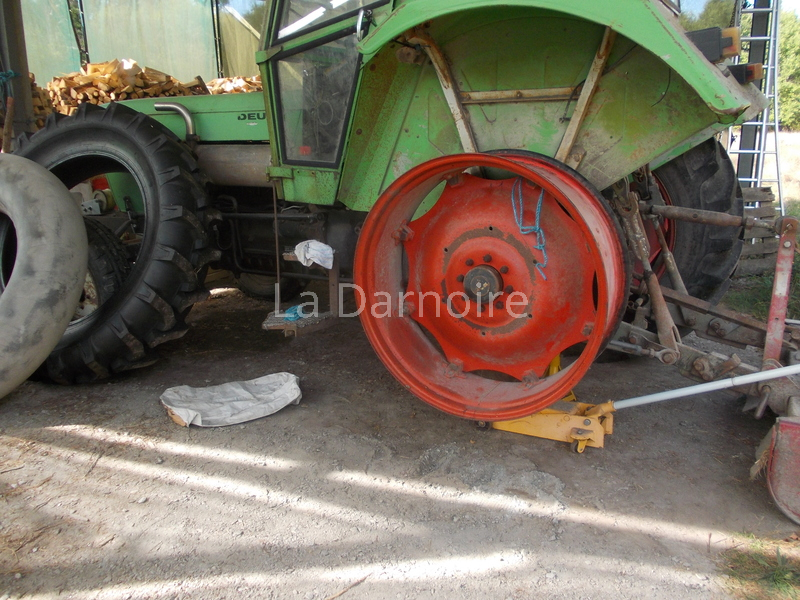
Tyre completely removed

In order to install the new tyre, I attempted something which works on car tyres – placing a rope around the well-lubricated rim, and pulling on the rope to seat the bead. Now I did ask AI whether this was possible, and the answer came back saying:

“No! Don’t do it! The rope will snap, the tyre bead is too strong, and you’ll severely injure yourself. Take the vehicle to an approved tyre centre instead.”*

*AI responses may include mistakes.

I tried anyway. And it worked. Sort of.
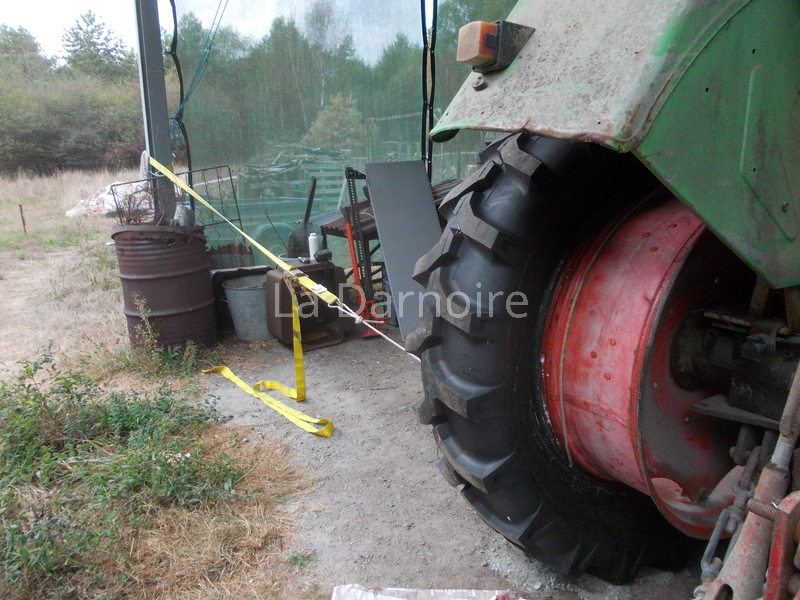
Attempting to seat the bead on the new tyre

I used a ratchet strap to apply the pulling force. It’s difficult to see in the photo, but the bottom of the bead has already seated on the rim. But just after this photo was taken, the rope simply pulled out of the gap between the tyre and the rim without getting the rest of the bead on. Upon later reflection, I should have varied the angle of pull of the ratchet strap by moving it upwards on the hangar support post. So, out with the tyre levers again. Using my body weight at the same time as gradually rotating the tyre, the bead eventually went on.
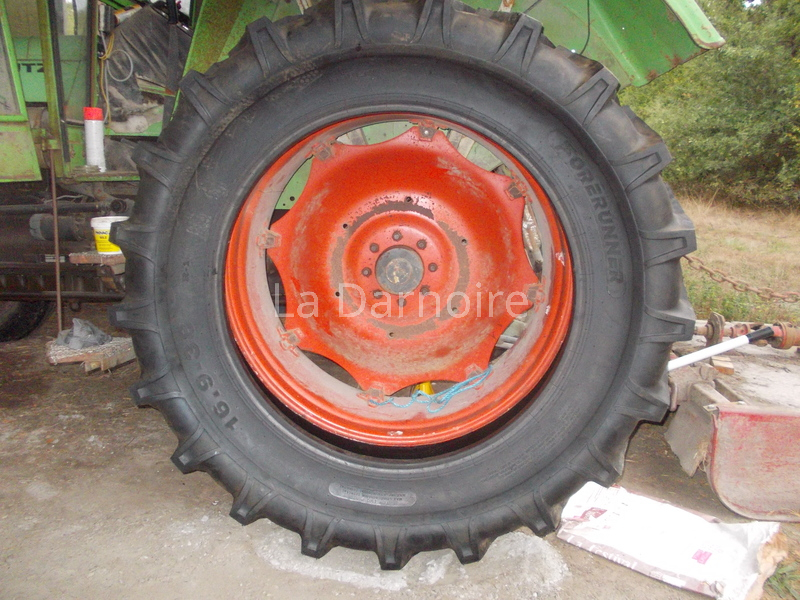
The inner bead is on!

The tube was then reinstalled, complete with the liquid which remained in the tube the entire time. I just had to be careful to make sure the valve was always at the top before deflating/inflating it! At this point I did inflate the tube partially in order to ensure it wasn’t twisted or pinched anywhere.

Now to seat the outer bead. Much struggling ensued before I realised there is a knack to doing this. The tyre needs to be moved inwards so that it falls into the centre section of the rim. This was achieved by once again using a ratchet strap and a block of wood. A pair of vice-grips helps to keep the bead from coming off entirely. (Note to self – must get more of these things.) The tyre levers then made short work of seating the remaining bead.
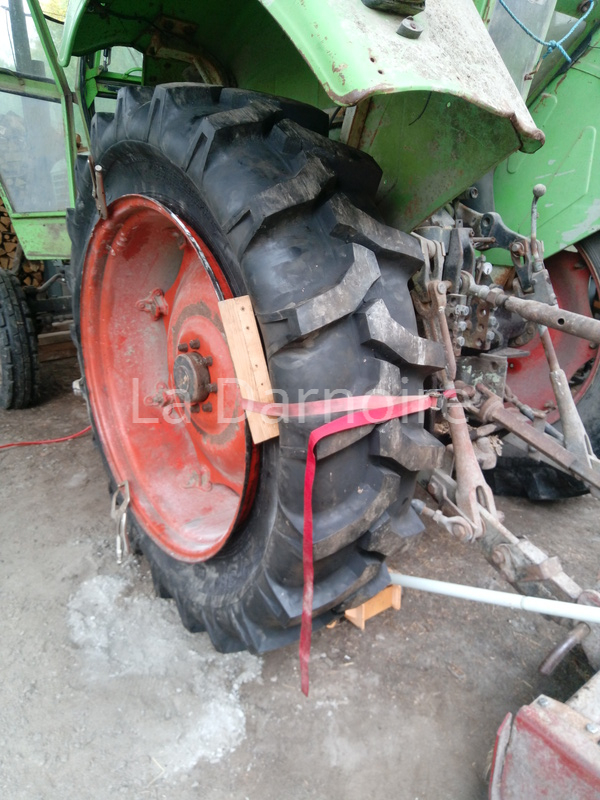
Outer bead installed!

The tube was then re-inflated. Job done!!
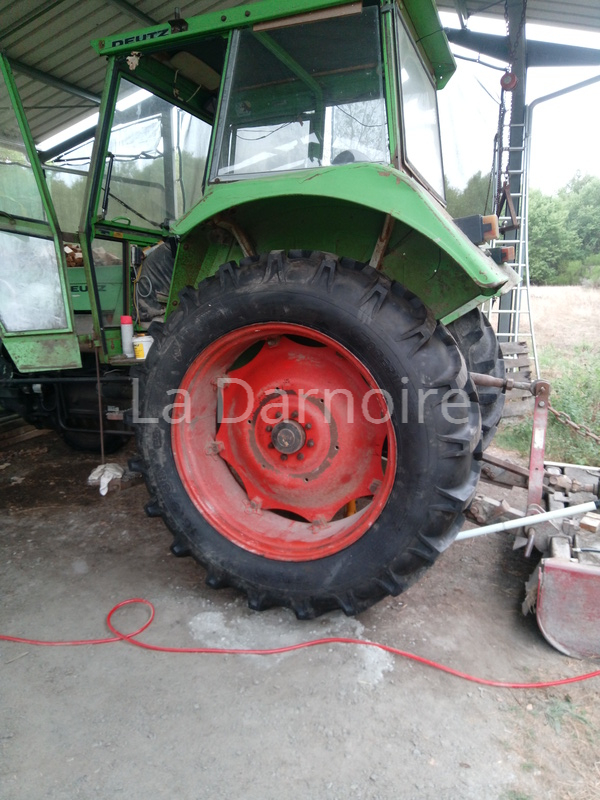
New tyre ready for use

At least now I know how to do it. And saved €300.
Fun with tractors

So there I was, cutting the grass in the alleyways in the woods with the tractor, minding my own business, and whistling the Toreador song from Carmen.
At least, I think that’s what I was whistling. The tractor is rather loud, so I couldn’t really hear myself.

And then…

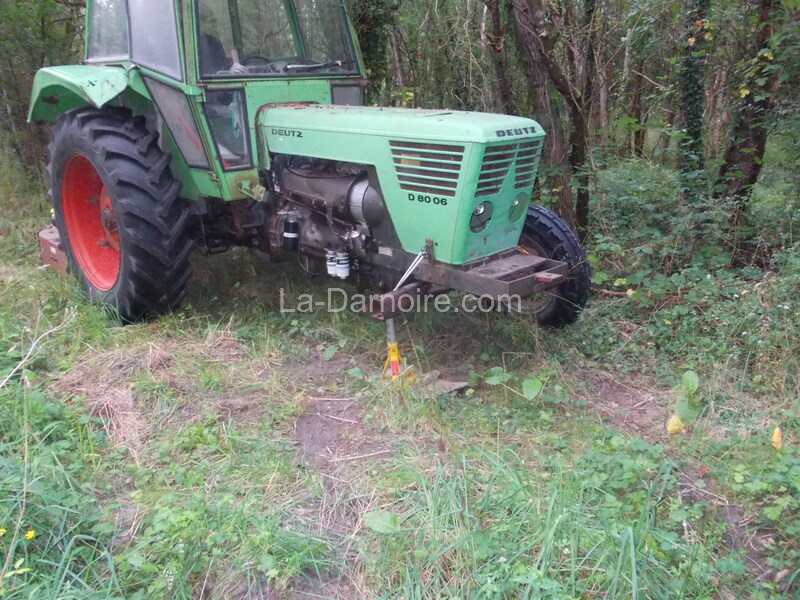
The tractor’s right front wheel fell off.

No, not the tyre. The entire wheel.

Well, that put paid to the grass cutting. I switched off, and got out to examine the damage.

The stub axle had simply sheared in half. So I got out the hi-lift jack and raised the front of the tractor. This was not as straightforward as usual, because the tractor appeared to have broken down slap-bang in the middle of the La Darnoire Horsefly Society’s Annual General Meeting.

I then walked back to the house, got the wheelbarrow and an axle stand, and brought the wheel back home (complete with hub).
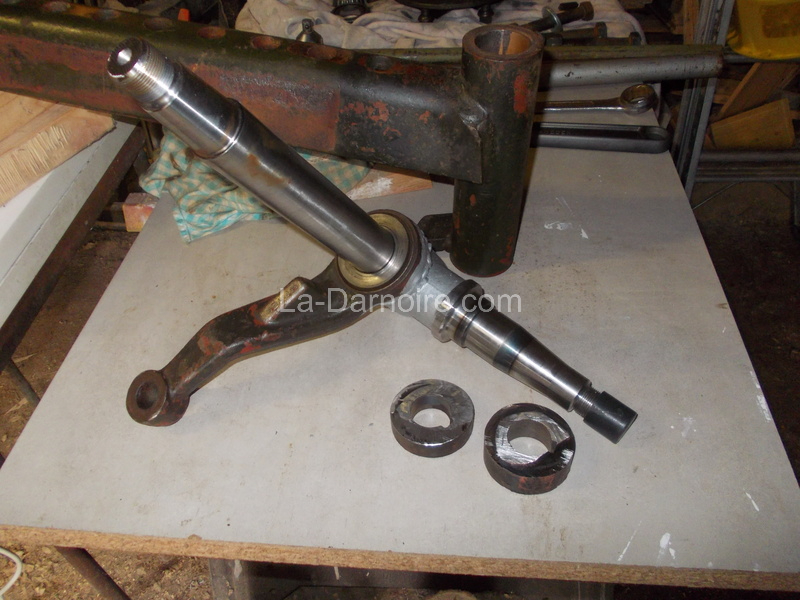
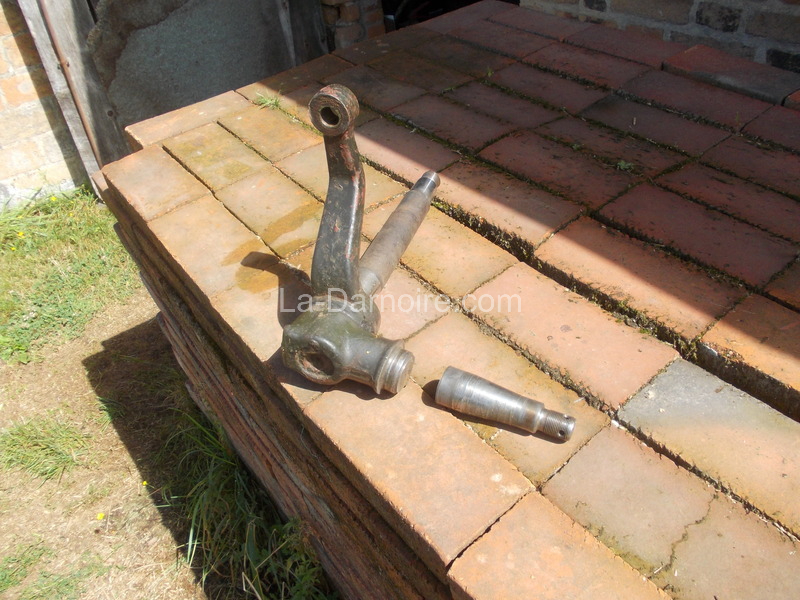
Fetching the heavy-duty spanners, it was a fairly easy task to remove the wheel from the hub. Here’s the broken bit (once I had everything taken apart of course!)

Broken stub axle

Then I took the spanners to the tractor.

For those who don’t know, the stub axle (which holds the wheel hub) is an integral part of a thing called a spindle. This is attached to the axle. In this particular tractor, a Deutz 8006, the axle is in two parts. This enables you to extend the front wheels outwards for added stability should you so desire.

However, due to rust, I was unable to extract the spindle from its housing in the axle. So this necessitated yet another trip back to the house for the super-heavy-duty shifting spanner, extension bar, and the old standby, a large hammer.

After an hour or so, I realised that this was just not going to work. The only option was to remove the entire half-axle.
Back to the house for the wheelbarrow.

The half-axle came out fairly easily, all things considered. Of course I had to remove half the steering tie rod as well, because the ball joint connecting it to the spindle was also rusted solid. Here’s what the tractor looked like after this operation (no, the bungee cord is not holding up the remains of the axle. It’s keeping the remaining half of the steering rod out of the way).

Half-axle removed

To cut a long story short, I soaked all the removed bits in diesel overnight, and then with a liberal spray of WD-40 and the application of the aforementioned hammer, everything could be separated into its component parts.

Although the stub axle could in theory be welded back on to the spindle, I don’t have access to a lathe. And my welding skills are somewhat rudimentary. So a new spindle was required.

This was when the fun started.

Numerous online tractor parts websites were visited. I eventually discovered that the broken spindle was not actually original. Not only that; it didn’t even belong to the same model tractor. It seemed to be the correct size for a Deutz 5206. Which is very different to the 8006. Prices for this part varied tremendously (even over €1000 at one site) but I finally tracked down a spares website in Germany, and managed to obtain the part for €79. Plus postage.

I couldn’t obtain the correct part for the 8006 because the connections to the steering arms were different. The late Aged FIL had obviously done some bodging in the past.

Of course when the part arrived, it was 20mm too short. I then discovered why. The late Aged FIL had welded a pitman arm to the spindle. This particular pitman arm is not a part belonging to the 8006. And it doesn’t quite fit on the 5206 in the place where it was located either; it should go at the top of the spindle, not the bottom. Yet another late Aged FIL bodge.

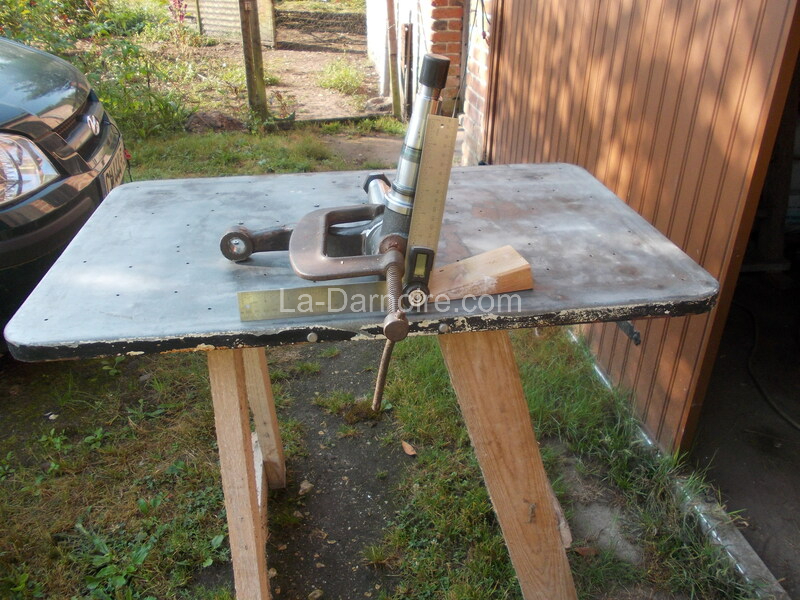
Well, there was no option but to cut off the old pitman arm, and weld it to the new spindle, in the same place as the old one. Just out of interest, I looked up the price of a new pitman arm. €845. No thank you. Before cutting off the old arm, I measured the angle between the arm and the stub axle, so that it could be connected in the same orientation on the new spindle:

Angle set to be the same as the old spindle

However, this led to a new issue. At the top of the spindle, just below the heavy-duty nut, is a conical washer. The only way I could get the nut to fit properly was by cutting the conical washer in half. With a hacksaw. Which was not enjoyable.
Still, a coat of paint later and the spindle was ready for reassembly. Here’s the cut washer – the thin half (the bit required) is 17mm thick. It’s in front of the new spindle, which is in front of the half-axle.

Washer cut in half, sort of.

I carted everything back to the tractor in the wheelbarrow, and put everything back together with loads of grease around the bits which should have grease.

Repair complete

The tractor is now operational again, yay.

Searching for water

When we had our borehole dug, I wished at the time I had filmed the professional dowser who told us where the water was. Well, a French newspaper, “La Nouvelle Republique” has just published a short video of the self-same chap. Even if you don’t understand French, it’s still a fascinating watch. These are the exact techniques he used to find our water source – which, by the way, is still going strong.

You can see the video here:

Tonight’s din-din

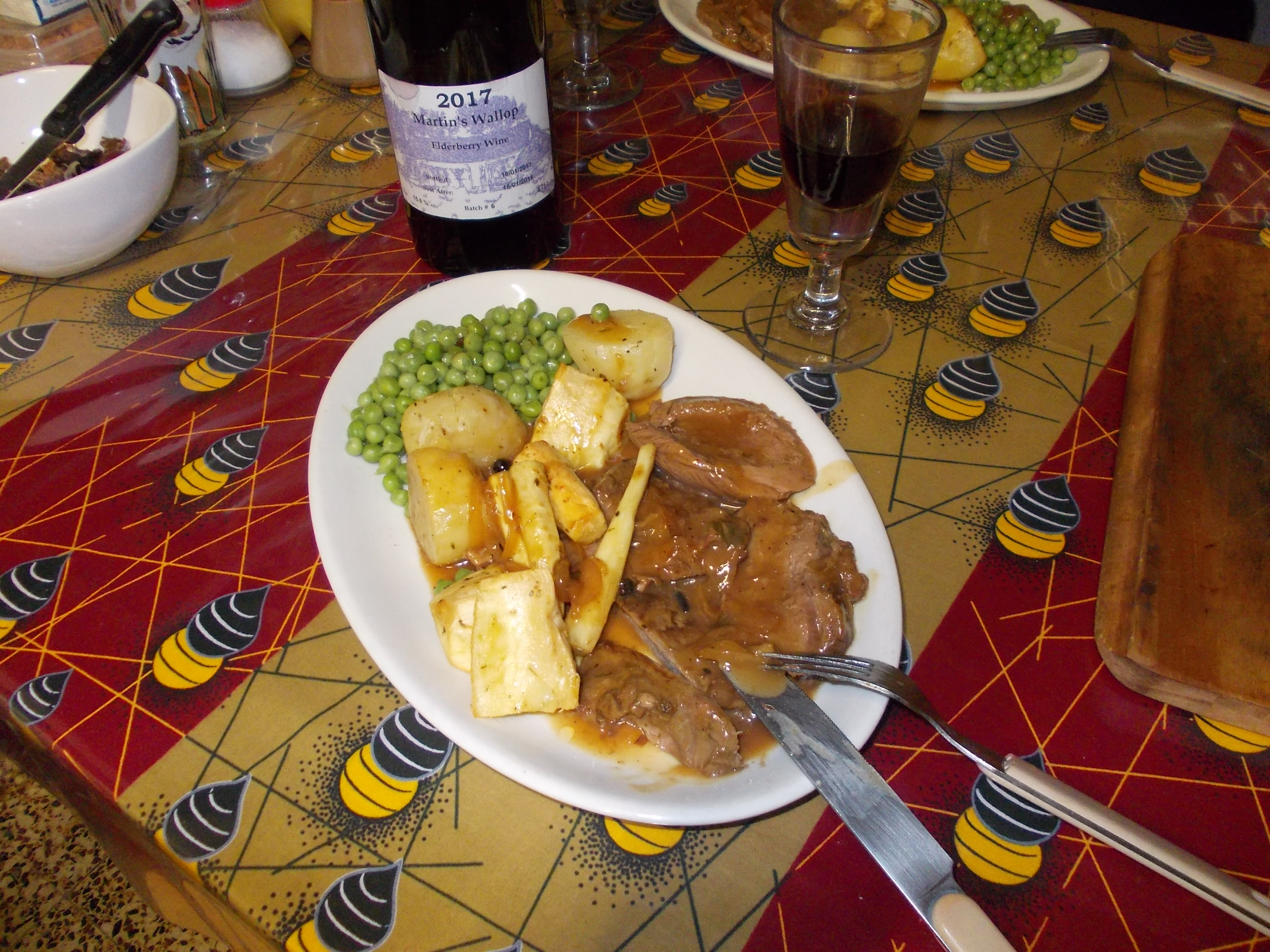
…was almost completely free. Roast venison from the property, (Yes. We ate Bambi. Get over it.) roast potatoes, roast parsnips, and peas. All from the garden. Even the elderberry wine is ours. The only things purchased were a couple of juniper berries, and a bit of cornflour in the gravy.Roast venison

“Ah, but what about the costs of cooking this dinner?” I hear you ask.

Pretty much zero as well. Cooked on the kitchen woodstove.

And a very tasty dinner it was too.

23/09/2018

It’s that time of year again. Harvesting sundry fruit and vegetables has been keeping us somewhat busy of late. Unfortunately we did not have a chance to eat any pears this year; the hornets scoffed the lot. We did however manage to collect some pears from the Aged FIL’s garden. They’re not very nice to eat, so instead we’ve turned them into 15 litres of perry.

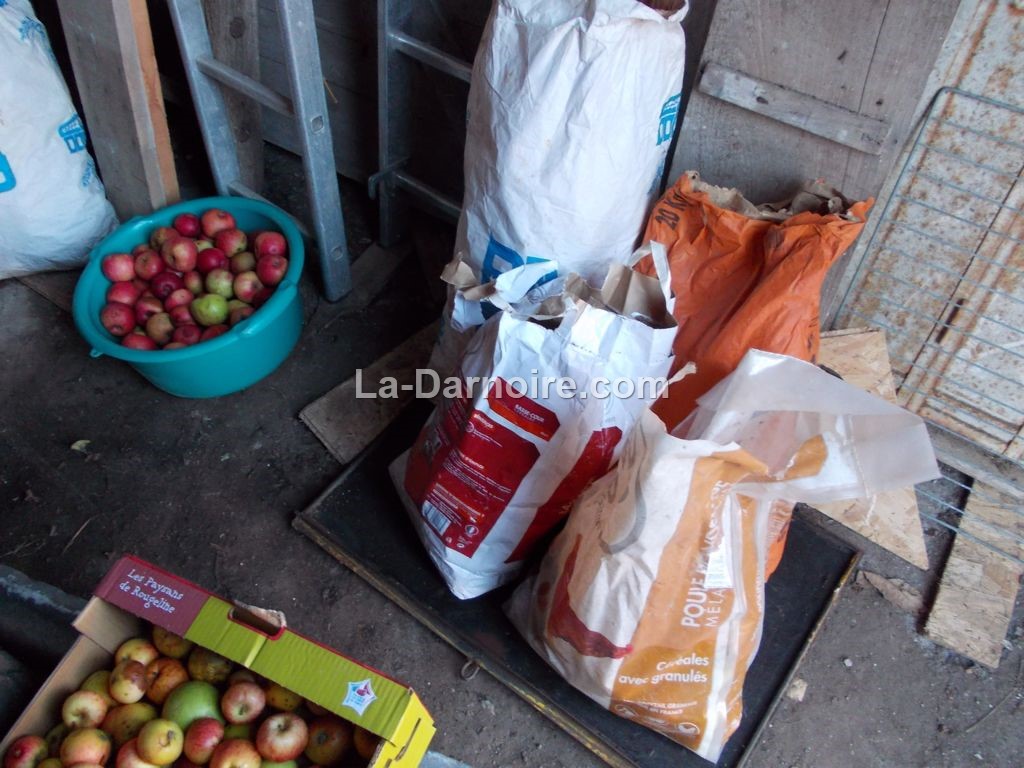
What about apples? Yes, we have those. Once the hornets had eaten all the pears, they turned their attention to the apple tree, so I harvested the lot. It’s only a small tree, so there were about twenty apples – but they are good. Obviously there weren’t enough to make any cider. But we went to see a retired farmer nearby. He has an orchard which he’s not really bothering about any more, so we came home with around 130kg of apples (there are more bags out of camera shot on the left…)Bags of apples
Nearly six hours of processing later, we had 75 litres of apple juice in a barrel, ready to be turned into cider. (I did a quick stock-take, and we do have enough bottles to contain it all – friends tend to bring us their empties for some strange reason.)

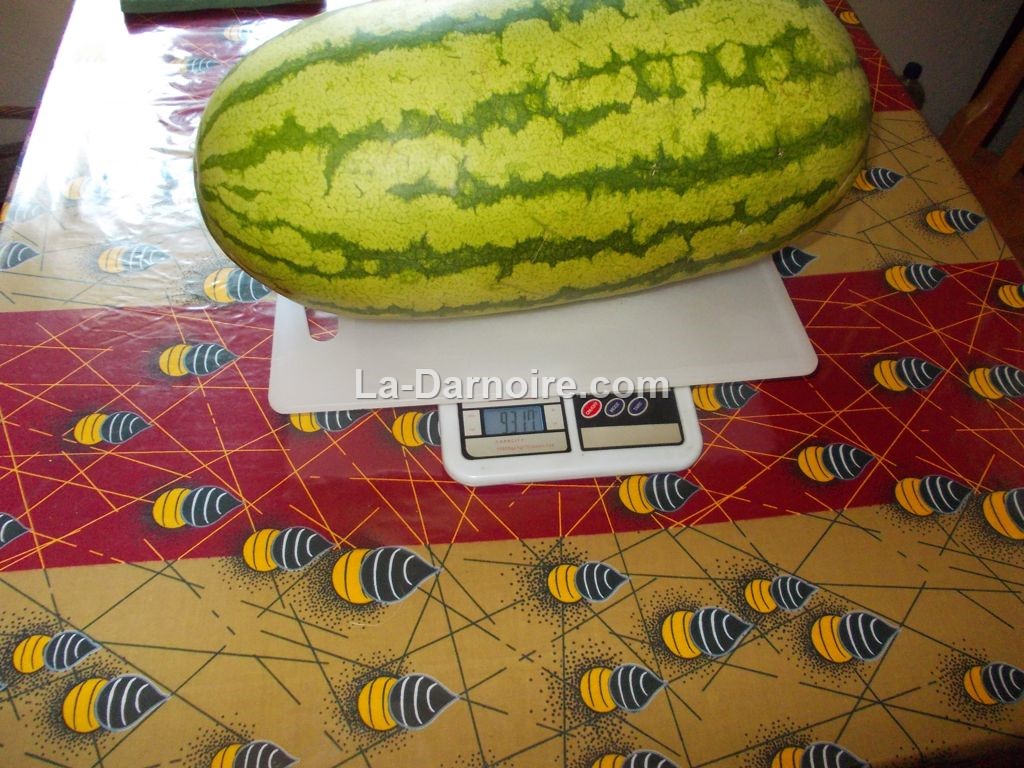
And whilst on the subject of fruit, this is only the second time in six years that LSS has managed to grow some watermelons. We have three; this is the largest at nearly 10kg: watermelon
Raspberries, blackberries and sloes have already been collected and frozen. And now the chestnuts are starting to fall. Everything is at least a month early this year.

LSS has also been busy processing the vast crop of tomatoes we have this season. So far she has produced 30 litres of tomato soup for the winter. Not to mention the numerous pots of canned tomatoes, and frozen stuffed tomatoes. It’s a good thing we now have the use of an additional freezer.

Oh, I didn’t tell you about that. No, we didn’t buy another freezer. We’re now using the one at the Aged FIL’s house. You see, he’s no longer there. He’s been in Orleans hospital since July, and has been gradually rising to the top of the waiting lists of several retirement homes. In fact, a couple of weeks ago he reached position number one on the list of a place called a USLD in Romorantin. (This French abbreviation means something like “long-term care home”. It’s a sort of hybrid between a retirement home and a hospital.) However, no sooner had the USLD telephoned LSS to say that they now had a room free, than the Aged FIL developed bronchitis, and the hospital refused to discharge him. He’s now due to enter the USLD on Monday, but even this is looking unlikely as he is now apparently suffering from an excess of sodium and is somewhat dehydrated. (Yes, he is in a French hospital).

So, to avoid any spoilage, we have been gradually clearing out the food storage cupboards in the Aged FIL’s kitchen, and using the additional space in his freezer.

Today’s food processing involves peaches. Lots of peaches. For the first time, the little peach tree outside the kitchen has produced a bumper crop. So LSS will be making jam, and peaches in syrup. I shall then try my hand at making mebos (dried peach fruit roll).

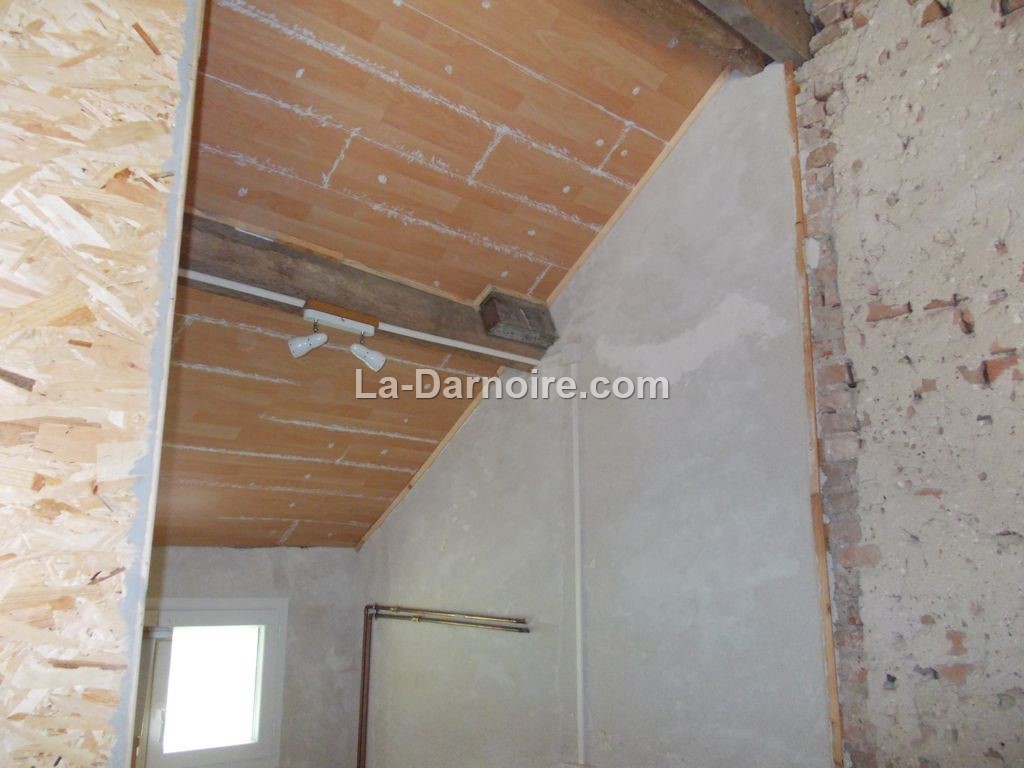
And as for the house renovation progress, LSS’s office area has been completed except for the painting. For all the ceilings in the barn, I actually used laminate flooring boards. Why? Three reasons:
a) I don’t like plasterboard; installing this on your own is not easy.
b) These boards actually weigh less than plasterboard.
c) They’re cheaper than plasterboard.

There’s a layer of glass fibre insulation between these boards and the rafters. As the ceiling in this area will be painted, I filled in the tiny gaps and screw-heads with caulk. (The wall on the right has been re-plastered since this photo was taken).Office ceiling
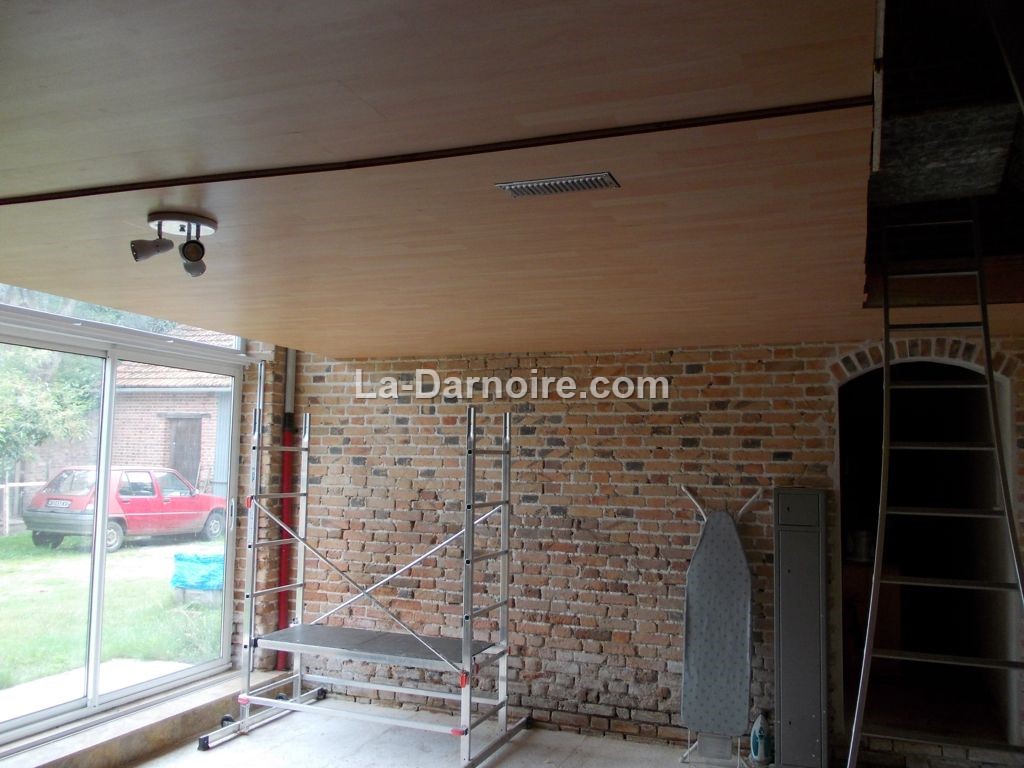
After this area had been completed, I decided to purchase a pneumatic nail gun. This proved to be a much easier way to fix the laminate boards, and the tiny brads are almost invisible. The rest of the barn ceilings were completed in this manner, and will not be painted:Laminate ceiling
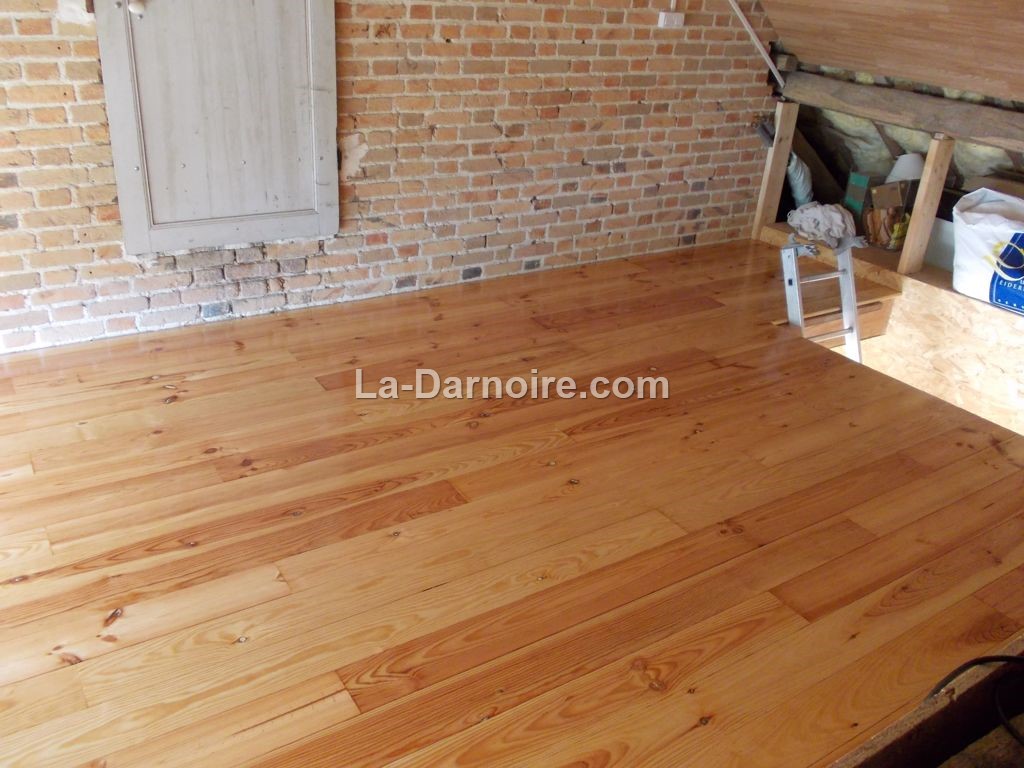
The upper level – which consists of the future bedroom and spare room – has also been constructed. This is the floor of what will be the future spare room: spare room flooring
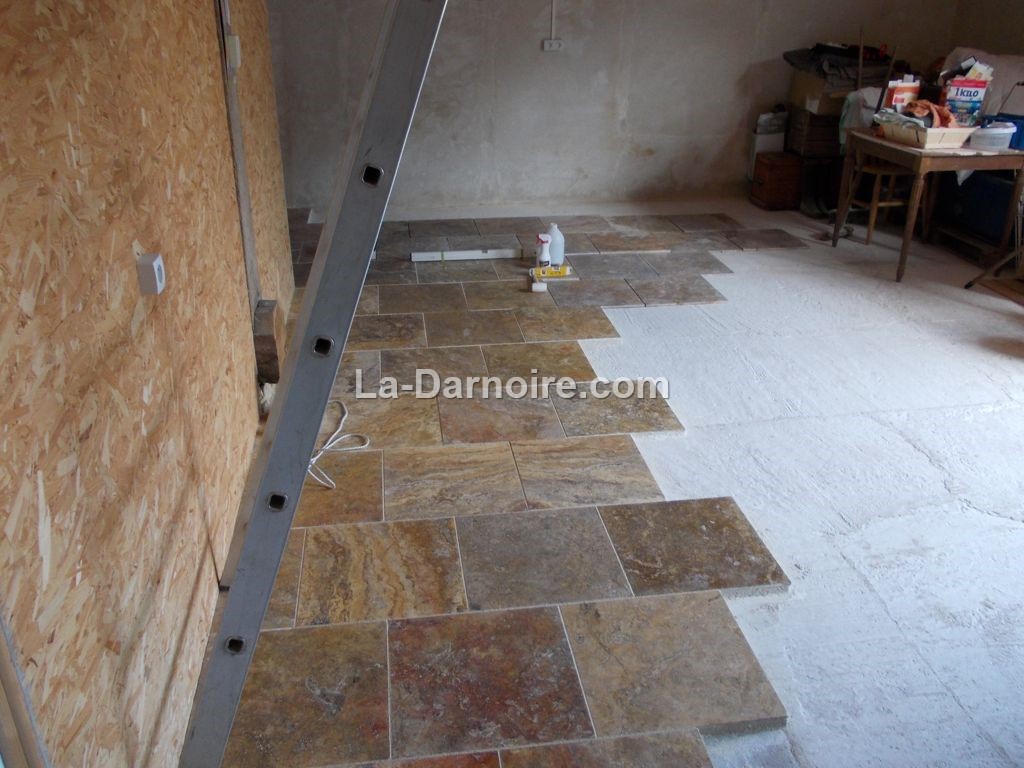
And in addition to the usual chores like cutting firewood, I have now started laying the remainder of the travertine tiles in the barn, with the goal of getting this finished before the end of October. travertine

So there you are. Now you know as much as I do.

19/07/2018

LSS again visited La Source, where she had a meeting with the Social Services officer of the Geriatric Department. Officialdom has now finally agreed that the Aged FIL can no longer receive the appropriate level of care at home; and when (actually more likely IF) he recovers sufficiently, he will be moved into an EHPAD (French nursing home for the elderly).

If he refuses this (which, knowing him, is highly likely), the necessary steps will be taken to have him declared incompetent, and LSS will then have the final say. However, his condition has not improved much since he was admitted; and the doctors have told LSS to prepare herself for the worst. “It could be weeks, or just a few months,” they said.

17/07/2018

LSS heard back from the lawyers regarding the “medical malpractice” affair with the Aged FIL. “Yes, everything is in order. However, in order to proceed further, we need signed witness statements from Seven Vestal Virgins, countersigned by the President.”

No, not really. But in other words, they cannot proceed without any written witness statements. LSS is trying to trace the chap who was in the bed next to the Aged FIL when the “incident” occurred. But is not having much luck.

In the afternoon LSS went back to Orleans La Source. The Aged FIL has now been transferred to the Geriatric unit, and has had the scheduled X-Ray for his broken arm. Apparently when he was last at this hospital, he discharged himself; even though they wanted to keep him there to make sure his arm was starting to heal.

Well, they’re keeping him now. For a while, anyway.

05/07/2018

Just after lunch, the hospital called LSS. “The Aged FIL has been repaired. So we’re sending him back home.”

“What, already!” exclaimed LSS. “Are you sure? The Home Nursing Service asked me to tell you that he will not be able to get the amount of specialised care he needs at home; therefore he should either stay in hospital until he’s completely better, or he needs to be referred to a retirement home catering for patients with special needs.”

“That is unacceptable,” said the hospital staff member. “He’ll be better off at home. His family should be looking after him, not us. So we’re sending him back now. Goodbye.”

Um, his family should be looking after him? What? That means LSS. Is she medically trained to operate lève-malades/change catheters/bed-sore bandages/nappies? No.

Gosh this hospital is good: curing someone of all their complaints within 24 hours! If you know anybody who’s ill, I strongly recommend that you send them to La Source in Orleans. Even Lourdes* is not as effective.
(/end sarcasm).

When the head of the Home Nursing Service was made aware that the Aged FIL had returned home, she telephoned the hospital herself. Unfortunately she received an ear-bashing instead of any assistance.

I suspect that tomorrow, or the day after, LSS will receive a telephone call from one of the carers, along the lines of “The Aged FIL is having <insert random problem here> again. Call the doctor quick!”
To which the reply will be “Unfortunately the local doctor is now on holiday. And there is no locum.” (True on both counts)

So the fire brigade will need to be called, to send an ambulance, to take him to hospital. Rinse and repeat.

Health Service? Don’t make me laugh.
We are considering selling the film rights to this story.

*A French town reputedly known for apparent miraculous healings

04/07/2018

A further update to the previous update’s update: Yesterday La Source sent the Aged FIL back with his arm in a sling. We’ve now had 24 hours of peace and quiet. There was a major meeting at the Aged FIL’s house containing most of the Management staff of the carer’s association, and the Management staff of the Home Nursing association. In brief, they said “Aged FIL, it would be better for you – in fact it would be better all round – if you went into a special-care retirement home. Just for a short while, you understand, until your condition has improved.”
His answer was very simple, and consisted of one word.
“No.”

During this twenty-four-hours-of-down-time, LSS discovered that the Aged FIL’s house insurance policy just so happens to include a thing called “Legal Cover”.

“I wonder if?” LSS mused.

So she rang the number provided, spoke to the lawyers, and explained the situation. “Oh yes,” they said, to the background sounds of ringing cash-registers. “What you’ve described to us about your father’s treatment amounts to what we call in the legal profession, ‘Medical malpractice’. Don’t worry about a thing. Send us all the documents and we’ll take care of it. We’ll send an RL (Registered Letter) to Monsieur HHH (Hospital Head Honcho), and then discuss CC (Compensation Claims). After all, caring for the Aged FIL is now going to be a lot more expensive, non?”
Marvellous. {Please understand, I’m summarizing here.}

Well, this evening, as we were putting our feet up and pouring a well-earned glass of Martin’s Wallop home-brew, the phone rang. It was the carer at the Aged FIL.

“He’s having trouble breathing, you need to call the doctor.” Yes, yes, all well and good. But the time happens to be 18h40. The doctor works office hours.

And, guess what?

Correct. There’s no reply from the doctor’s telephone number. LSS abandoned her half-finished glass of Martin’s Wallop finest home-brew (accept no imitations), and went next door to see what was what.

I eyed her half-full glass speculatively, but decided that discretion was the better part of valour, so left it alone.

The ambulance was called (i.e. LSS called the emergency services, which is the fire brigade, which sends an ambulance)… and the Aged FIL will shortly be whisked off to the hospital. Which hospital? Well, the one the fire brigade here normally uses, of course.

And which one would that be?

Answers on a postcard to… no, I’ll save you the bother. Romorantin.

I wonder if they’ll break his other arm this time.

NEWSFLASH…. LSS put her foot down. And to everyone’s surprise, asked if the ambulance staff could take him to La Source in Orleans instead. “Oh,” they sighed. “Well, I suppose we could make an exception. Just this once.”

Stay tuned for more exciting developments…